 '
 '
 '
 '
 '
 '
 '
 '
 '
 '
 '
 '
 '
 '
 '
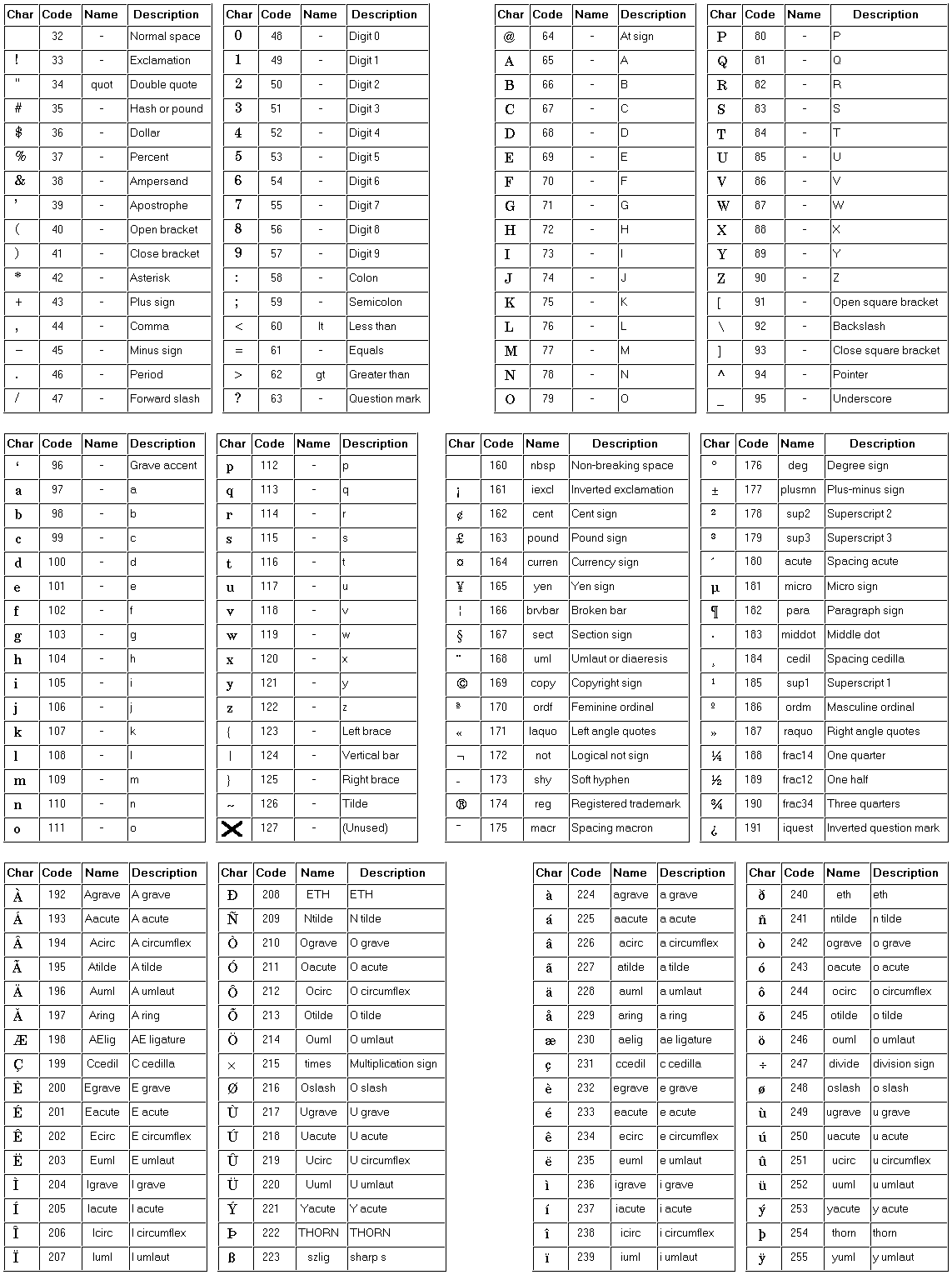
The following tables give all characters which are available in the ISO Latin 1 character set. In each table, you will see four columns:
In all cases, you may use the decimal code number to represent the character, or the entity name if that's available. A number is used like this: © to represent the 169th character. Since this character also has a name, you can also use © to represent it.
1. utf-8 explicitly does not define displayable characters for positions 0-31 and 127-159, and the HTML standard does not allow those to be used for displayable characters. The only characters in this range that are used are 9, 10 and 13, which are tab, newline and carriage return respectively. If you attempt to display these invalid characters on your own system, you may find some characters displayed there, but please do not assume that other users will see the same thing (or even anything at all) on their systems.
2. Although the specs require that all browsers support this character set, not all actually do. In particular, Macintosh browsers display the following 15 characters incorrectly:
'''''''''''''''Macintosh users might want to install CourierWeb, monospaced font that can display all entities correctly. Alan Flavell maintains a more extensive dicussion of this topic.
3. In most cases, you will not need to use the " entity for the double quote ("). It might come in handy if you need it inside a quoted attribute value, for example as in ALT="My "new" site".
________
© 1996 Arnoud "Galactus" Engelfriet
URL: http://www.stack.nl/~galactus/
E-mail: galactus@htmlhelp.com
________
Original of this page is on WDG site:
URL: http://www.htmlhelp.com/reference/charset/